
Source verification for Midnight Compact contracts, available as a CLI and TypeScript/JavaScript functions. Freeze and compile the source, then submit the same snapshot to Subscan and wait for the verification result.
Version 0.1.0 is the initial client release under the MIT license. The recorded live workflow covers Preview with Compact 0.31.1; Preprod, Mainnet and server-side acceptance remain separate. Verification reuses the existing Subscan backend and midnight-go. The verification client requires no wallet, Blockfrost endpoint or additional service deployment. See design and release boundaries and the release checklist.
Requires Node.js >= 22.16:
npm install --save-dev midnight-verify-plugin
npx midnight-verify --help
Import verifyContract and the other public functions from midnight-verify-plugin, or run the CLI with npx midnight-verify. Actual builds also require an installed Compact compiler and its key-generation tools. Set SUBSCAN_API_KEY through your shell or CI secrets when submitting verification.
See the Usage Guide for compilation, deployment, verification, DApp integration and receipt-based recovery.
Watch the silent 1080p walkthrough (2 minutes 51 seconds): build and inspect a frozen source bundle, configure the API key, run verification, and check the result on Subscan. The recording rechecks an already verified Preview contract; it does not deploy a new contract or submit new source.
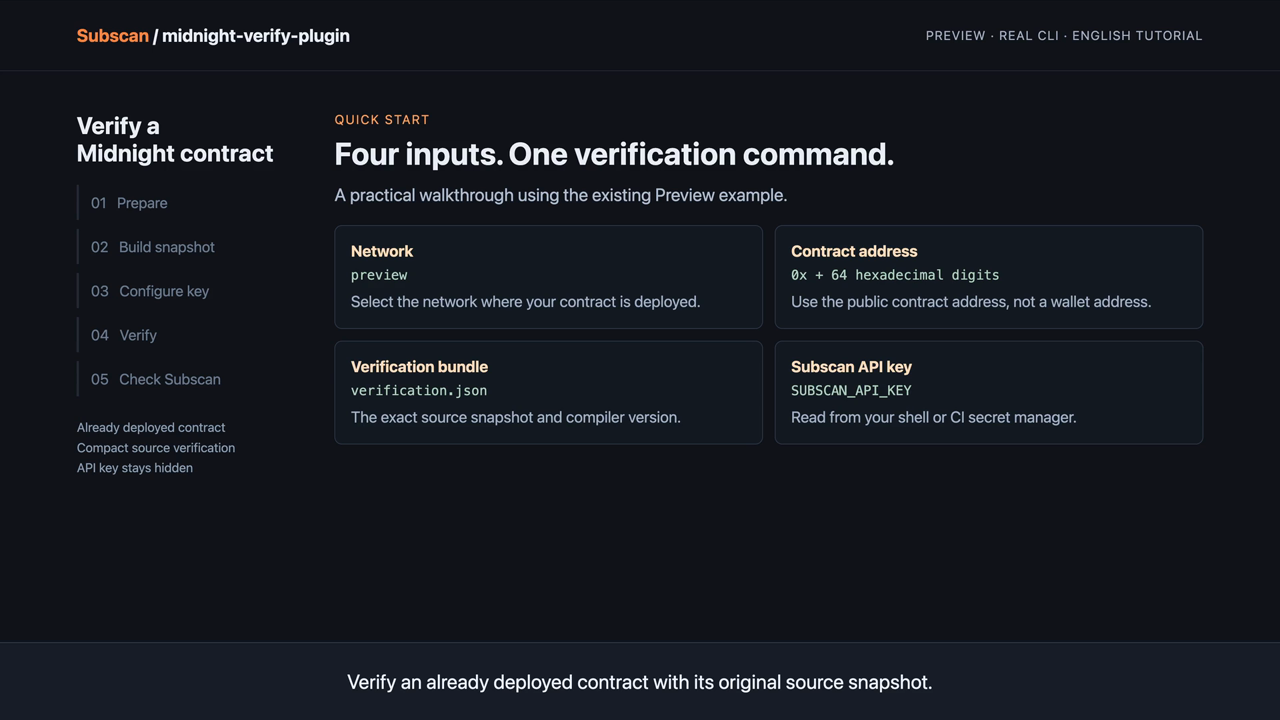
Watch the video · Download MP4 · English subtitles · Written guide
The MP4 includes English subtitles and chapter markers. If your player does not display embedded subtitles, load the .srt file linked above. Tutorial media is stored in this repository and excluded from the npm package.
Requires Node.js >= 22.16 and npm. Actual Compact builds also require an installed compiler and its key-generation tools. File-system and HTTP tests use local fixtures and require neither a compiler installation nor an API key.
npm ci
npm run check
npm test
npm run check:release
npm test builds the TypeScript output. Use npm run build to build it separately. There are no runtime npm dependencies; development dependencies are locked in package-lock.json. Release checks validate English text and documentation links, inspect the package contents, and install the tarball into an isolated consumer to test its exports, CLI and TypeScript declarations. They do not deploy contracts or publish packages.
CI checks Linux and macOS with Node.js 22.16.0 and 24. Artifact publication reserves a new output directory and copies its contents without overwriting existing targets; this also supports Node 24's stricter directory-copy checks. See GitHub Actions for current results.
Before public submission, release checks also reject credential literals, wallet identities, internal endpoints and sensitive files, including force-added ignored files. Keep wallet state and authentication files outside publication inputs. See the publication safety review for scope, evidence and repeatable checks.
The following command freezes the source, compiles the snapshot in a temporary directory, checks compiler metadata and required prover/verifier keys, and writes deployment artifacts with verification.json:
npx midnight-verify build \
  --source-dir examples/hello-world \
  --entry main.compact \
  --compiler-version "$MIDNIGHT_COMPACT_VERSION" \
  --out managed/hello-world

npx midnight-verify inspect \
  --build-info managed/hello-world/verification.json
Set MIDNIGHT_COMPACT_VERSION in your shell or CI to an exact version, or replace the flag value with that version. There is no implicit version default. 0.31.1 is the version validated on Preview, not a fixed client allowlist. The output directory must not exist. Use a new directory for another build; existing deployment artifacts are never overwritten. Deploy with the artifacts from that directory and verify with its bundle. Do not use pragma language_version as the compiler version.
The multi-file example preserves relative imports:
npx midnight-verify build \
  --source-dir examples/multi-file \
  --entry main.compact \
  --compiler-version "$MIDNIGHT_COMPACT_VERSION" \
  --out managed/multi-file
Only .compact files in the selected directory are collected. The .git, node_modules, managed, dist and target directories are excluded. Unused Compact files in the selected directory are included, so choose a clearly scoped contract directory. The inspect command prints the version, entry file, digest and filenames without networking or source contents.
The first version supports default compiler arguments, relative imports and the built-in standard library. Nonempty COMPACT_PATH is rejected; arbitrary compiler flags are not forwarded. The compiler must produce compiler/contract-info.json with an exact compiler-version and circuits metadata. Older versions lacking these fields cannot produce a verification bundle. Actual compilation has been validated with Compact 0.31.1; an API-supported version is not automatically a tested version.
Use --compiler-mode compact (default) for compact compile +<version>, or --compiler-mode compactc to invoke a compiler directly. Set --compiler-bin to override the executable. Environment fallbacks are MIDNIGHT_COMPACT_VERSION, MIDNIGHT_COMPACT_MODE and MIDNIGHT_COMPACT_BIN; explicit flags take precedence. Both modes check the actual version in the generated metadata and reject mismatches. The E2E --deploy mode accepts these settings; --resume preserves the bundle and receipt's recorded version.
Verification publishes the Compact source in the bundle. Set SUBSCAN_API_KEY through your shell or CI secrets. Never put it in source files, bundles or command-line arguments. Verification does not require deployment private state.
# Set SUBSCAN_API_KEY and assign the public deployed address to MIDNIGHT_CONTRACT_ADDRESS.
npx midnight-verify verify \
  --network preview \
  --address "$MIDNIGHT_CONTRACT_ADDRESS" \
  --build-info managed/hello-world/verification.json
The network option accepts preview, preprod and mainnet. Hex addresses may have a 0x prefix; Bech32 addresses are not yet supported. Default API hosts:
| Network | Subscan API |
|---|---|
| preview | https://midnight-preview.api.subscan.io |
| preprod | https://midnight-preprod.api.subscan.io |
| mainnet | https://midnight.api.subscan.io |
The client first queries /api/scan/midnight/compact/version and waits for the contract to be indexed. It does not resubmit an existing successful or running verification. Otherwise, it submits once to /api/scan/midnight/verify, then queries /api/scan/midnight/contract.
A response with code: 0 means only that the request was accepted. The CLI succeeds only after observing a success record whose exact compiler version and complete source match the local snapshot. An existing record for different source returns matchesBundle: false.
If the submission acknowledgement is lost, the client continues reading status. A total timeout returns pending, without another POST or deployment. The service currently provides no job ID: verified means a matching address-level success record was observed after a submission attempt. It does not prove ownership of an individual job, constitute a security audit, or establish verification after a maintenance update.
| Exit code | Meaning |
|---|---|
| 0 | Build/inspect succeeded, or a matching verification record was observed |
| 1 | Input, compilation, API or explicit verification error |
| 2 | Pending confirmation; JSON phase is indexing, submission-unknown or verifying |
| 4 | A success record exists for different source or compiler version |
| 130 | User cancellation or compilation cancelled by timeout |
Persist the public deployment receipt before invoking verification. Verification failure must never trigger automatic redeployment or transaction rebroadcast.
After installing the npm package into your DApp, call it from the existing Midnight.js deployment script:
import { verifyContract } from 'midnight-verify-plugin';

// deployed comes from deployContract; its public receipt has already been persisted.
const abortController = new AbortController();
const result = await verifyContract({
  network: 'preview',
  address: deployed.deployTxData.public.contractAddress,
  buildInfo: './managed/hello-world/verification.json',
  signal: abortController.signal,
});

if (result.status === 'pending') {
  console.log('Awaiting confirmation', result.contractUrl);
} else if (!result.matchesBundle) {
  throw new Error('Existing verification does not match this source snapshot');
} else {
  console.log(result.status, result.contractUrl);
}
Exports include buildVerificationBundle, loadVerificationBundle, validateBundle, normalizeAddress, verifyContract, PluginError and their TypeScript types. The library and CLI share the same implementation. The verification client is independent of a specific Midnight.js SDK version.
| Item | Current setting |
|---|---|
| Source files | At most 128 files, 256 KiB per file and 2 MiB total |
| Verification bundle | At most 4 MiB of serialized JSON |
| Scanning | At most 4096 entries and 32 levels; symlinks and noncanonical relative paths rejected |
| Compilation | 120-second default; configurable with --timeout-ms; --compiler-mode selects compact / compactc, and --compiler-bin overrides the trusted executable |
| Verification | 10-minute default; 30-second request timeout; polling backs off from 1 to 10 seconds |
| HTTP responses | At most 8 MiB; redirects rejected to prevent forwarding authentication headers |
| API override | --api-url / apiUrl accepts an HTTPS origin; HTTP is restricted to local test addresses |
| Library controls | AbortSignal, timeoutMs, requestTimeoutMs, pollIntervalMs, maxPollIntervalMs |
Cancellation controls the directly started compiler process; it does not guarantee termination of every descendant of a custom compiler on every platform. Client-side path and size checks do not replace independent server-side controls.
Local tests cover frozen source, relative paths, digests and limits, missing keys, stale errors, concurrent tasks, lost acknowledgements, timeouts, cancellation, rate limiting, key redaction and CLI exit codes. Single-file and multi-file examples have compiled with Compact 0.31.1 and generated keys and bundles.
On October 3, 2026, 27 local tests passed, followed by a real Preview run using an authorized test wallet: frozen multi-file compilation, deployment, Subscan verification, independent persisted-result checks and public-page confirmation. Verification returned verified and matchesBundle: true. After stopping the local proof server, receipt-based verification returned already-verified without another deployment. See the Preview E2E report.
Compiler version, mode and executable configuration subsequently increased the local suite to 34 passing tests. These cover flag/environment precedence, different versions, direct compactc arguments, mismatch rejection, API version preflight and preserving the deployment version during resume. A real direct compactc 0.31.1 build also generated complete keys with the same source digest as the Preview deployment. Other compiler versions were exercised through local fixtures, not live network acceptance.
Release preparation increased the local suite to 37 passing tests, adding checks for English text, portable paths and documentation links. TypeScript checking, tarball inspection and isolated consumer API, CLI and declaration checks passed on macOS arm64 with Node.js 22.16.0. The Linux/macOS CI matrix with Node 22.16.0 and 24 subsequently passed in the public repository. See the release checklist for validation and acceptance boundaries.
The October 8 publication review increased the suite to 43 passing tests, added credential/file safeguards and sanitized wallet identity from receipts and harness output. Redacted scans covered all publication candidates and the actual npm package. These checks do not establish a general security audit or network acceptance.
The initial npm release distributes the client. Preprod and Mainnet acceptance and independent server-side requirements remain outstanding. Package publication does not deploy or upgrade the backend/helper services, establish a security audit, or prove verification after contract maintenance.
See the protocol, engineering decisions, Subscan verification guide, Compact compiler usage and Midnight deployment interfaces.
Instructions for the opt-in live compile, deploy and verify test are in e2e/README.md. Ordinary npm test uses local fixtures only.