ceph-windows: cross-compile in a podman container instead of a VM - #2694
ceph-windows: cross-compile in a podman container instead of a VM#2694djgalloway wants to merge 8 commits into
Conversation


The windows CI cross-compiles Ceph inside a freshly provisioned libvirt
Ubuntu VM on every run: download the cloud image, boot, cloud-init, rsync
the tree in, build everything (including all the mingw deps) from scratch,
rsync ceph.zip back out, destroy the VM.  That was ~50 minutes of a recent
successful run before the cluster-side work even started.

win32_build.sh is a plain Linux mingw cross-compile, so run it in a podman
container on the builder host instead: a static toolchain image (the apt
packages from win32_deps_build.sh's ubuntu branch), the workspace bind-
mounted, and two host-side caches that survive between builds:

- the compiled mingw deps (mingw-llvm, boost, openssl, ...), keyed by the
  sha of the branch's win32_deps_build.sh + mingw_conf.sh + the
  containerfile, so any deps change simply builds a new cache entry;
  win32_build.sh already skips the deps build when it finds the cache's
  completed marker
- ccache for the ceph tree itself (CMake picks the launcher up from
  CMAKE_C/CXX_COMPILER_LAUNCHER), with fixed container mount paths so
  object paths stay stable across builds and nodes

The new ceph-windows-container-build job validates this on the same
builder pool the windows test jobs use, without touching ceph-pr-pipeline
or the existing windows jobs; it doubles as a one-off manual windows build
job for a branch or PR.  Once proven, ceph-pr-pipeline's windows leg will
switch to it, leaving libvirt only for the Windows client VM.

Assisted-by: Claude Fable 5 (claude-fable-5)
Signed-off-by: David Galloway <david.galloway@ibm.com>
mingw_conf.sh defaults MINGW_LLVM_DIR to $CEPH_DIR/build.deps/mingw-llvm,
which only coincided with the deps location while DEPS_DIR used its
default.  With the deps cache mounted at /depscache the llvm-mingw
toolchain was downloaded there but never found, and the deps build died
at the first x86_64-w64-mingw32-clang invocation (lz4).

Assisted-by: Claude Fable 5 (claude-fable-5)
Signed-off-by: David Galloway <david.galloway@ibm.com>
Replace the windows leg's first libvirt Ubuntu VM (provisioned, built in,
and destroyed on every run) with win32_build_container: the mingw
cross-compile now runs in a podman container on the builder host with the
compiled deps and ccache persisted between builds.  Validated standalone
by the ceph-windows-container-build job: 17.7 min cold / 5.5 min warm for
what took ~50 min in the VM.  Only the vstart cluster host and the
Windows client remain libvirt VMs.

The cross-build tree is dropped after zipping so setup_ceph_vstart's
rsync doesn't ship it to the cluster VM (do_cmake.sh refuses to run in a
tree with a build dir); on failure the build logs are archived before
cleanup wipes the workspace.

Assisted-by: Claude Fable 5 (claude-fable-5)
Signed-off-by: David Galloway <david.galloway@ibm.com>
Run 88 landed on braggi12 (jammy), where setup_container_runtime.sh
falls back to docker because jammy's podman is too old, and the
container build died on "podman: command not found".  All but four of
the libvirt builders are noble, where podman works -- require noble,
like the bwc-based legs already do.

Assisted-by: Claude Fable 5 (claude-fable-5)
Signed-off-by: David Galloway <david.galloway@ibm.com>

|
Now integrated into ceph-pr-pipeline's windows leg and validated end to end: pipeline run 89 ran the full leg for ceph PR 71382 (windows check only,
Old ceph-windows-pull-requests successes ran 114–177 min. Also in this branch: the windows leg now requires |
The windows leg's remaining Ubuntu VM existed only to build (32 minutes,
from scratch, every run) and host the vstart cluster.  Build and run it
in a bwc container on the builder host instead: same Release build and
vstart configuration as the VM flow, but the bwc image has the build
deps baked in and a persistent host-side ccache makes repeat builds
fast.  The cluster container runs with --net=host and vstart binds the
libvirt bridge address, which the Windows client VM reaches directly
over the default NAT network.  The only VM left is the Windows client
itself.

The container path is self-contained per run (no coupling to the shared
build leg or the S3 cache), so it behaves identically in full runs and
windows-only re-runs.  run_tests grows a VSTART_CONTAINER mode for its
cluster-side diagnostics (podman exec / local log copies instead of ssh
into the VM); with the variable unset its behavior is unchanged for the
old ceph-windows-pull-requests job, which shares the script.

Assisted-by: Claude Fable 5 (claude-fable-5)
Signed-off-by: David Galloway <david.galloway@ibm.com>
Run 92's dokan tests all failed with EACCES: vstart writes "mds root ino
uid/gid = $(id -u/-g)" into the MDS config, so a cluster started by
container root creates a cephfs whose root inode is owned by 0:0 -- and
the windows client mounts with client_mount_uid/gid = 1000 and
client_permissions enforced, so every write is denied.  The VM flow
never hit this because vstart ran as the ubuntu user (uid 1000).

Start vstart as a uid-1000 user in the container, exactly like the VM
flow.  The cluster's files on the host are then owned by a subuid, so
the conf/keyring copies go through podman cp and the log collection
through podman exec + tar.

Assisted-by: Claude Fable 5 (claude-fable-5)
Signed-off-by: David Galloway <david.galloway@ibm.com>
|
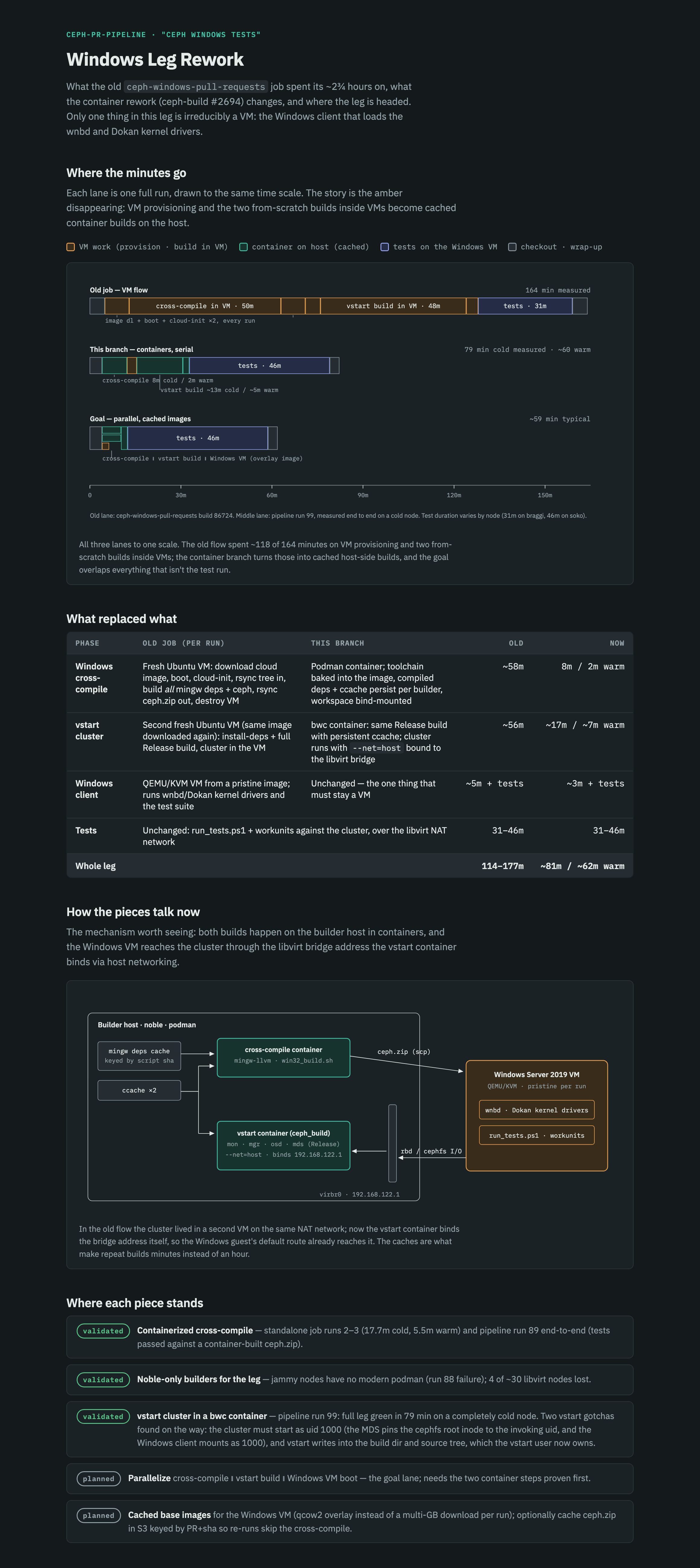
vstart-in-container is now validated end to end as well: pipeline run 99 ran the full windows leg on soko12 with completely cold caches — 79 min, SUCCESS, all tests passed (ceph_test_dokan ~15 min, matching the VM-cluster baseline). Cold breakdown: ~12.5 min cross-compile (image + deps + build, fresh node), ~13 min windows VM + vstart build + cluster up, ~48 min tests, ~4 min artifacts. Warm nodes should land around 60-65 min. Two vstart behaviors surfaced during validation (runs 92/97/98), for the record:
The READY wait also fails fast now when the container exits, instead of sitting out its timeout. Whole leg, measured: 114–177 min (old VM flow) → 79 min cold / ~60 min warm, with only the Windows client VM remaining as a VM. |

478708a to
a4d723c
Compare
Runs 97 and 98 failed one file at a time: vstart writes an environment
helper (vstart_environment.sh) next to itself in the source tree, and
logrotate.conf (plus all of VSTART_DEST) in the build dir -- both
root-owned in the container, so the uid-1000 cluster died on Permission
denied after coming fully up.  Auditing vstart.sh's write surface:
everything lands under the build dir, src/vstart_environment.sh, or
/tmp -- so chown the build dir to the vstart user wholesale and hand it
that one src file.  The host-side cleanup already uses sudo rm, so
subuid-owned files are fine.

Also fail the READY wait as soon as bwc reports the container command
failed, instead of sitting out the full 900s timeout on a cluster that
already died.

Assisted-by: Claude Fable 5 (claude-fable-5)
Signed-off-by: David Galloway <david.galloway@ibm.com>
Walk through the leg's steps and how the pieces fit together: the
cross-compile container and its two per-builder caches, the libvirt
network, the vstart cluster container (--net=host on the virbr0
address, started as uid 1000, and why), the Windows VM as the one
remaining VM, and the run_tests VSTART_CONTAINER mode.

The vstart step is spelled out in plain terms: nothing prebuilt is
downloaded and "Release" is a cmake build type, not a Ceph release --
the PR's own merged tree is compiled inside a container and started as
the cluster, so daemon-side changes are tested on both sides of the
wire exactly like the VM flow; ccache is a per-builder stash of object
files, so only the PR's actual changes recompile.

Point the standalone job's README at this section and refresh the
stale windows rows in the flow overview.

Assisted-by: Claude Fable 5 (claude-fable-5)
Signed-off-by: David Galloway <david.galloway@ibm.com>
a4d723c to
149b429
Compare
|
The rework at a glance — old VM flow vs this branch vs the goal, on one time scale, plus how the containers, caches, and the Windows VM fit together:
|
1 participant

The windows CI cross-compiles Ceph inside a freshly provisioned libvirt Ubuntu VM on every run: download the cloud image, boot, cloud-init, rsync the tree in, build everything (including all the mingw deps) from scratch, rsync ceph.zip back out, destroy the VM. That was ~50 minutes of a recent successful run (ceph-windows-pull-requests #86724) before the cluster-side work even started.
win32_build.shis a plain Linux mingw cross-compile, so this runs it in a podman container on the builder host instead:scripts/ceph-windows/win32-build.containerfile) with the apt packages fromwin32_deps_build.sh's ubuntu branchscripts/ceph-windows/win32_build_containerbind-mounts the workspace and produces the same$WORKSPACE/ceph.zipthatsetup_libvirt_windows_vm/run_testsconsumewin32_deps_build.sh+mingw_conf.sh+ the containerfile, so any deps change simply builds a new cache entry;win32_build.shalready skips the deps build when it finds the cache's completed marker (a flock guards the first build per key)The new
ceph-windows-container-buildjob validates this on the same builder pool the windows test jobs use, without touching ceph-pr-pipeline or the existing windows jobs; it doubles as a one-off manual windows build job for a branch or PR.Validation on braggi07 (ceph main):
vs ~50 minutes for the VM-based build phase it replaces. Not yet validated: running the produced ceph.zip through the actual windows tests — that's the next step before switching ceph-pr-pipeline's windows leg over.
Assisted-by: Claude Fable 5 (claude-fable-5)